Clutter or hoarding: when it becomes a health issue
Families ask us to settle this argument fairly often, usually with one relative saying it is fine and another saying it is not. We cannot diagnose anybody, and we would not try. We can tell you what we look at.
The test is function, not volume
A full home where everything still works is a full home. The line gets crossed when the contents start preventing the home from doing what a home has to do.
That reframes the conversation usefully, because it moves it off taste and habits and onto things that are either true or not.
The practical signs
- Exits and routes. Can the front door open fully, and can somebody get from the bedroom to the door quickly in the dark.
- The kitchen. Whether food can be prepared and stored safely, and whether there is spoiled food in the room.
- The bathroom. Whether it can be used and cleaned, which is often the first thing to go and the last thing anybody mentions.
- Sleeping. Whether the bed is still a bed, or whether the person is sleeping in a chair because the bed has become storage.
- Pests. Droppings, insects, or a neighbour raising it. Pests do not stay in one unit.
- Smell. Especially anything that has become normal to the person living there and obvious within a second to a visitor.
- Weight and stacks. Piles above head height, and floors carrying loads they were not designed for.
What is usually underneath
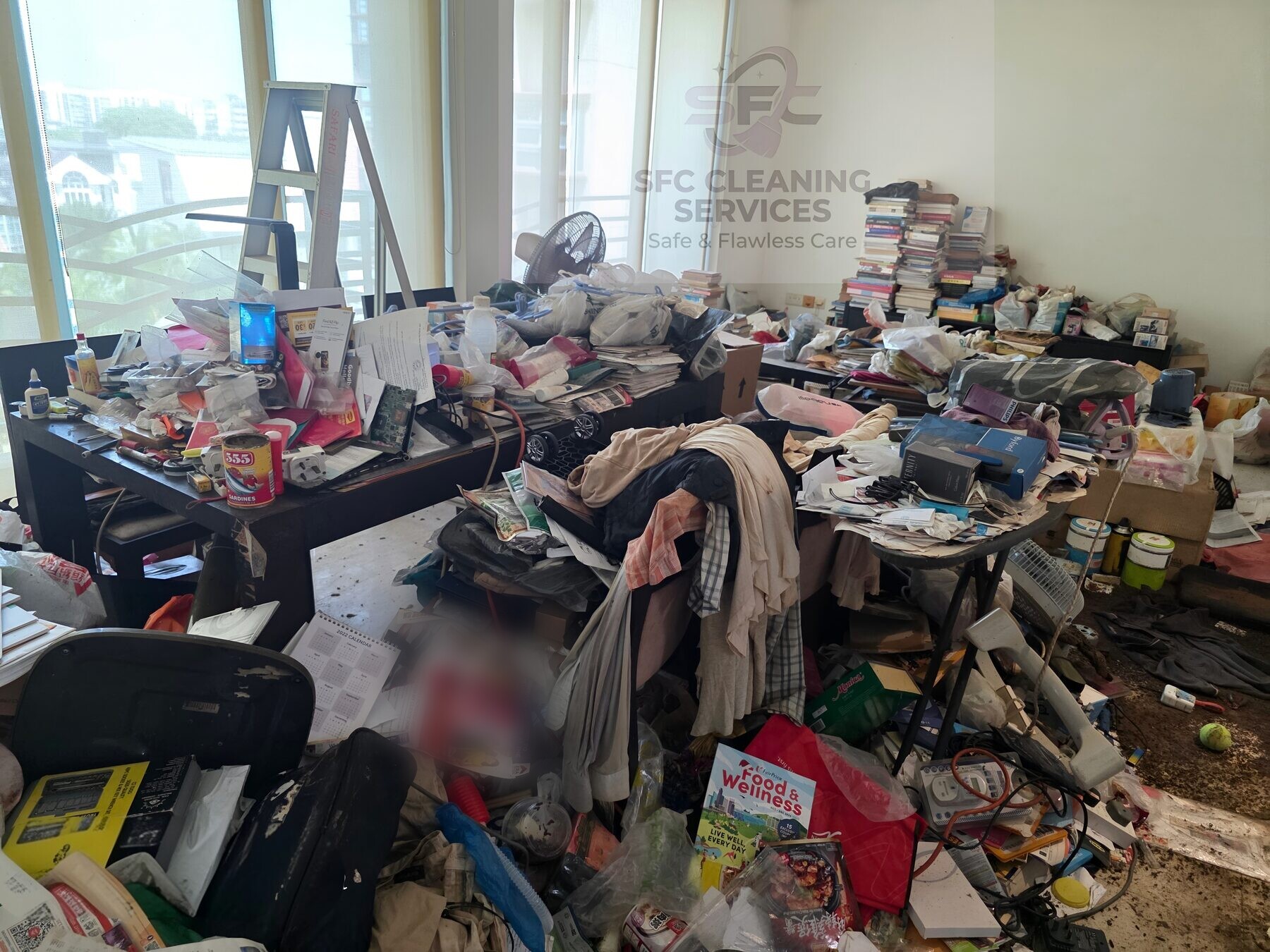
The volume itself is mostly labour and trips. What makes it specialist work is what tends to be under it: spoiled food and organic waste, pests, biological waste in units where somebody has been unwell for a long time, and damage to flooring, walls and occasionally wiring that nobody could see.
None of that is visible from the doorway. It is why the unit gets looked at in person rather than assessed from a photograph.
If a neighbour or the management has raised it
Then it has already crossed a line for somebody else, which is its own kind of answer. We are not able to tell you what your town council or building management will do, and we will not guess at their process. Ask them directly, and get the unit looked at in the meantime.
What we do not do
We do not assess people, and we do not turn up to persuade anybody. We look at a property, tell you what the work involves, and do it if and when it is agreed. The conversation with the person living there is covered in how to talk to a parent about a hoarded home.
The service is hoarder disposal and clearance.
Photograph it, gently
Where a family disagrees about how serious something is, photographs settle it faster than argument, because the person who says it is fine is usually describing the flat as it was two years ago.
Take them for the practical things rather than for effect: the front door’s swing, the route from bed to bathroom, the kitchen work surface, the state of the bathroom. Those are the things anybody you eventually involve will ask about.
Do it openly rather than covertly. Being photographed without knowing is a fast way to lose the trust you will need shortly afterwards.
Where a health concern belongs
We are cleaners. If your concern is somebody’s physical or mental health rather than the state of a property, that belongs with a doctor or the relevant service and not with us, and it should not wait on a cleaning decision.
The two can run alongside each other. A unit being made safe does not require anybody to have resolved the larger question first, and waiting for that can mean waiting a very long time.
If the person has been unwell for a long period, there is more in deep cleaning a home after a long illness, and on assessment in why a hoarded home has to be looked at in person.