Cement, grout and paint marks: what actually removes them
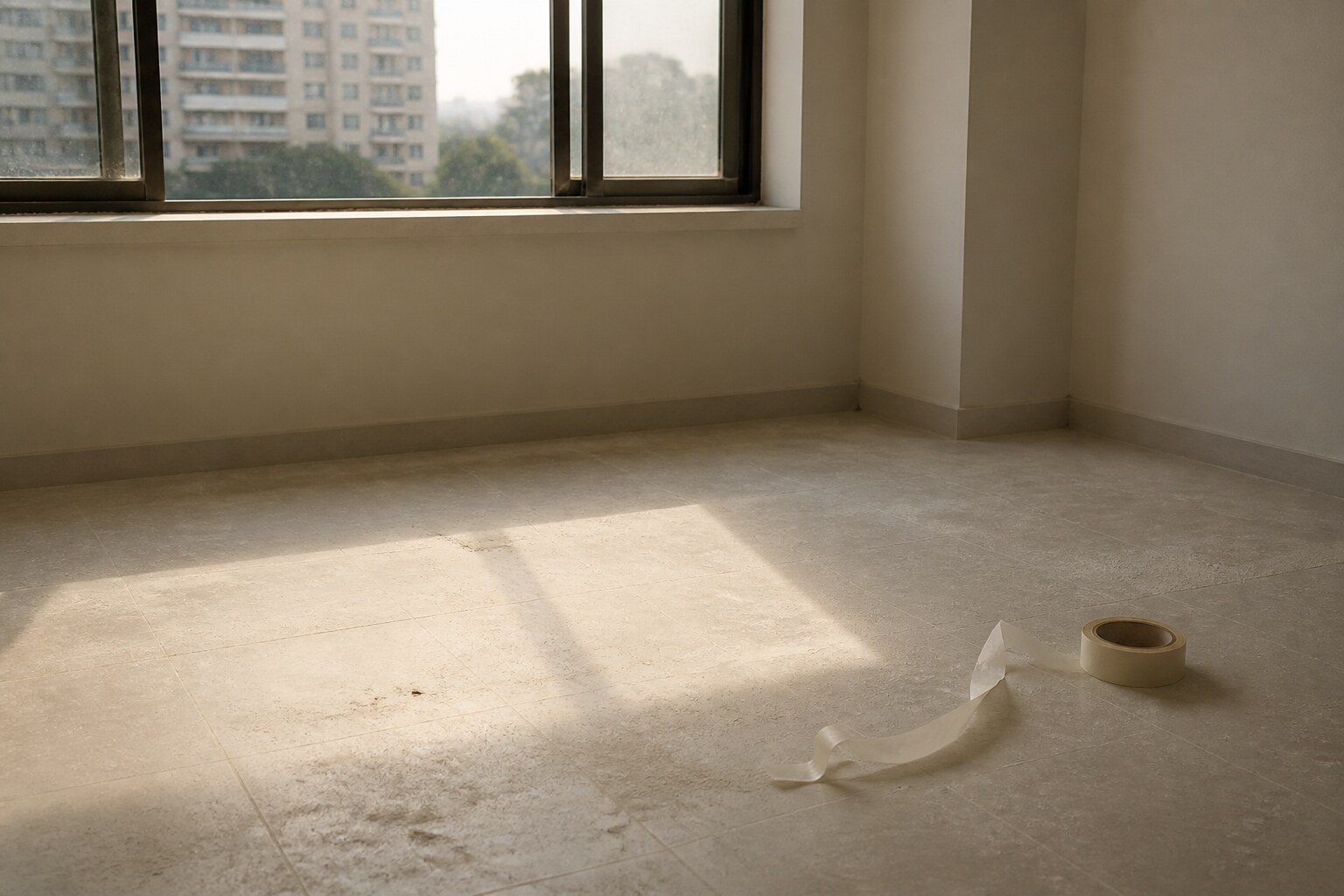
Almost every renovated unit hands over with some of this on it. It is normal, it is not a sign of bad work, and most of it comes off. The risk is in how.
Cement haze
The dull film across tile that survives mopping and reappears as it dries. It is a mineral deposit, so water alone will not shift it and more scrubbing mostly polishes it.
It needs the right treatment for the tile, applied and then fully rinsed. The mistake that costs money is reaching for an aggressive acid on a surface that cannot take it, which etches natural stone and strips the finish off polished tile permanently.
Grout residue and smears
Different from haze, because it sits proud rather than as a film. It has to be softened and lifted rather than scraped, and the joint itself has to survive the process, since gouged grout then holds dirt for the life of the floor.
Paint
- On glass, flecks lift with the right blade at the right angle, wet, in one direction. Dry scraping puts fine scratches across a whole pane and they only show in daylight, by which point it is too late.
- On tile and stone, solvent choice depends on the surface more than on the paint.
- On hardware and powder coat, solvent is usually the wrong answer entirely, because it takes the coating with it.
- On timber and laminate, mechanical removal is a real risk to the finish and worth being conservative about.
Silicone and adhesive
Cured silicone does not dissolve, it has to be cut and lifted cleanly, and a rushed job leaves a ragged line that then has to be redone properly. Adhesive on skirting and frames is usually solvent work, again decided by what is underneath it.
Every one of these is a question about the surface, not about the mark. Identify the surface first and the method picks itself.
Test somewhere that does not matter
Inside a cabinet, behind a door, under an appliance. Whatever you are about to use, use it there first and wait. Most permanent damage in this category happens in the first ten seconds of enthusiasm.
What to raise with the contractor
Photograph anything significant while the unit is still empty and the trades are still nearby. Some of this is fair to hand back rather than to solve yourself, and it is far easier to raise on day one than in week three.
The service is post-renovation cleaning, and there is a walkthrough list in what to check before you move in.
What is worth leaving alone
Not everything that looks like residue is residue. Natural stone has variation, some tile finishes are deliberately uneven, and a mark that will not shift after a reasonable attempt is often the material rather than something on it.
The damage in this category almost always comes from the second and third attempt rather than the first, when somebody moves up to a harsher product or a stiffer pad because the gentle version did not work.
If two sensible attempts have not moved it, stop and ask somebody rather than escalating. A dulled patch on polished tile does not come back.
Order of operations
Dust first, then residue, then floors, then glass. Doing glass early means doing it twice, because everything above it is still to be dealt with and will land on it.
Within a room, work top down for the same reason, and keep whatever you are using off adjacent surfaces. Most of the accidental damage we see was not done to the surface being cleaned but to the one next to it.
The wider list is in what to check before you move in.